

The Europe Medical Imaging Equipment Market to reach USD 1.54 billion by 2031, Germany Holds 26.4% Market Share | DataM
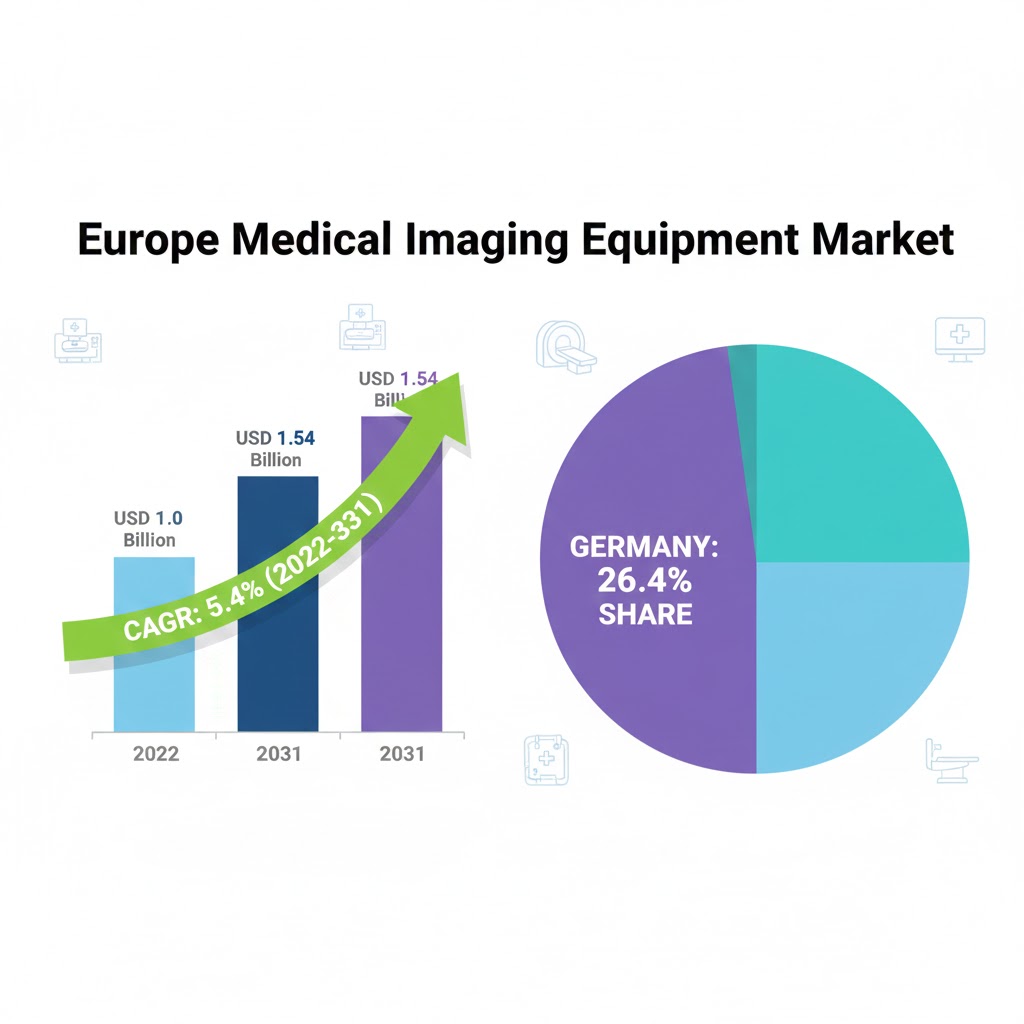
The Europe Medical Imaging Equipment Market size was valued at USD 1.08 billion in 2021 and is estimated to reach USD 1.54 billion, exhibiting a CAGR of 5.4% .
Europe's medical imaging equipment market is poised for robust growth, driven by technological innovation and rising healthcare demands, with key players focusing on AI integration and sustainability.”
AUSTIN, TX, UNITED STATES, December 1, 2025 /EINPresswire.com/ -- The Europe Medical Imaging Equipment Market size was valued at USD 1.08 billion in 2021 and is estimated to reach USD 1.54 billion, exhibiting a CAGR of 5.4% during the forecast period (2024-2031).— DataM Intelligence
Medical imaging allows medical examiners to observe the inside of a body to establish a medical condition using techniques and machines such as Magnetic Resonance Imaging (MRI), X-ray and Computed Tomography (CT) scan.This imaging allows radiologists and other health professionals to picture the structures and activities occurring inside the body.
Download your exclusive sample report today: (corporate email gets priority access):https://www.datamintelligence.com/download-sample/europe-medical-imaging-equipment-market
Key development:-
- In July 2025, Siemens Healthineers rolled out a next-generation MRI system in Germany with AI-powered image reconstruction technology offering faster scans, improved image quality, and enhanced diagnostic precision across hospitals.
- In June 2025, Philips Healthcare committed €250 million to expand its medical-imaging R&D centre in the Netherlands, focusing on AI-driven imaging workflows and radiology innovations to support Europe’s growing diagnostic demands.
- Across 2025, multiple European hospitals in Germany and Italy adopted modular cloud-based and SaaS medical imaging solutions blending AI-assisted imaging, digital diagnostics, and remote reporting for oncology and neurology applications.
- Canon Medical Systems Corporation acquired Esaote SpA, and GE Healthcare merged with Hitachi Medical Systems, reflecting consolidation trends in the market.
- Additionally, there has been significant progress in AI-powered imaging devices and the growing adoption of telemedicine. The market growth is fueled by rising chronic disease prevalence, aging populations, increased healthcare spending, and innovations like helium-free MRI technology and AI integration in imaging diagnostics.
Recent Mergers & Acquisitions-
- KARL STORZ acquired T1V’s medical business, including the CollaboratOR system, to strengthen its global digital surgery suite (Q4 2025).
- Aptyx acquired Medical Murray’s North Carolina facility specializing in catheter‐based interventional products and transcatheter implants, supporting its next-gen system launch (Q4 2025).
- Siemens Healthineers and Philips Healthcare launched new MRI and hybrid imaging platforms as part of strategic expansions in Europe, signaling related M&A and partnership activities (Q4 2025 estimate).
Market Segmentation-
- By product Type:- In terms of product type or imaging modalities, the market includes X-ray imaging (both digital and analog), Magnetic Resonance Imaging (MRI), ultrasound, CT scans, and nuclear imaging. Among these, MRI is expected to dominate due to its non-invasive nature and superior soft tissue contrast, making it widely preferred for neurology, oncology, and musculoskeletal diagnostics. MRI advances like 3T and 7T technologies further boost its market share by providing high-resolution imaging, which aids in early disease detection and treatment planning.
- By application:- The medical imaging market segments into oncology, cardiology, orthopedics, and other medical fields. Oncology holds the largest revenue share driven by the increasing prevalence of cancer and reliance on PET-CT, MRI, and CT scans for tumor detection and therapy monitoring. Cardiology is the fastest-growing segment, fueled by the rising burden of cardiovascular diseases and advancements in echocardiography and cardiac MRI, which improve early diagnosis and patient care.
Regarding portability, the market is divided into stationary X-ray imaging systems and portable systems. Stationary systems currently dominate due to their widespread use in hospitals and diagnostic centers, offering higher image quality and integration with hospital IT infrastructure. However, portable X-ray systems are experiencing faster growth driven by their convenience in emergency care, home healthcare, and remote or resource-limited settings, where quick and mobile diagnostics are crucial.
- By end users:- The market includes hospitals, diagnostic centers, and research centers. Hospitals hold the largest revenue share because they provide comprehensive imaging services across a broad patient spectrum, supported by extensive infrastructure and expertise. Diagnostic centers are growing due to demand for quicker, more accessible imaging services with transparent pricing models, while research centers primarily utilize imaging equipment for clinical studies and innovations.
Buy Now & Unlock 360° Market Intelligence:- https://www.datamintelligence.com/buy-now-page?report=europe-medical-imaging-equipment-market
Regional Insights:-
- Germany leads the Europe market, commanding the largest revenue share of approximately 26.4%. This dominance stems from its advanced healthcare infrastructure, widespread adoption of cutting-edge imaging technologies such as MRI, CT, and PET scanners, and strong presence of major imaging equipment manufacturers. Government support for digital health transformation and high diagnostic imaging utilization rates further bolster Germany's leadership position.
- France holds a significant share and is one of the fastest-growing markets in Europe. Public investments like the EUR 7.5 billion Health Innovation Plan, part of which targets digital health applications and AI-ready imaging systems, drive growth. France's market growth is fueled by increased adoption of advanced imaging modalities in oncology and cardiology along with favorable reimbursement policies to support early diagnosis and treatment.
- The United Kingdom is a major European market with strong demand for diagnostic imaging driven by an aging population and chronic disease burden. Expansion of outpatient and mobile imaging service models in the UK supports greater access and faster diagnostics. However, challenges like radiologist shortages impact growth pace somewhat, though government initiatives promoting digital health integration provide support.
- Italy is another important regional market with steady growth attributed to increasing investments in healthcare infrastructure and modernization of hospital imaging systems. The aging population and rising demand for cancer and cardiovascular diagnostics contribute to the expanding need for MRI, CT, and ultrasound equipment.
Market Drivers:-
- Aging population and increasing chronic disease prevalence, especially cancer and cardiovascular conditions, driving demand for diagnostic imaging.
- Continuous innovation in imaging technologies such as AI integration, helium-free MRI, and photon-counting CT systems enhancing diagnostic accuracy.
- Hospital modernization and increased digital health investment improving imaging infrastructure and capacity.
- Expansion of outpatient and mobile imaging services providing faster, accessible diagnostics outside traditional hospital settings.
- Government initiatives promoting early diagnosis, digital health integration, and favorable reimbursement frameworks supporting technology adoption.
- Rising use of minimally invasive image-guided procedures boosting demand for high-resolution imaging modalities.
Get Customization in the report as per your requirements:https://www.datamintelligence.com/customize/europe-medical-imaging-equipment-market
Key Players:-
The key players in the Europe Medical Imaging Equipment Market are Siemens Healthineers, GE Healthcare, Koninklijke Philips, Canon Medical Systems Corporation, and Fujifilm.
-Siemens Healthineers, headquartered in Germany, is a global leader in medical imaging, laboratory diagnostics, and advanced therapies. The company is known for integrating AI technologies into its imaging devices, enhancing early disease detection and diagnostic precision, especially in cancer, cardiovascular, and infectious diseases. Siemens has a large installed base across Europe and is recognized for innovation and extensive R&D investment.
-GE Healthcare is a major competitor specializing in imaging, ultrasound, and life sciences. It has invested heavily in AI-enabled diagnostic devices to improve accuracy and workflow efficiency. GE Healthcare’s AI-powered systems are widely adopted across hospitals and clinics, offering personalized and connected care that is reshaping diagnostic processes.
-Koninklijke Philips, another key player, focuses on a broad portfolio including MRI, CT, ultrasound, and X-ray systems. Philips emphasizes digital health solutions and AI integration to enhance diagnostic imaging quality. The company is active in developing portable imaging solutions to meet the growing demand for mobile and outpatient diagnostics.
Competitive landscape-
The competitive landscape of the Europe Medical Imaging Equipment Market is moderately concentrated, dominated by global leaders such as Siemens Healthineers, Philips, and GE Healthcare. These companies hold significant market shares and drive innovation through advanced technologies like AI integration, photon-counting CT, and helium-free MRI systems. Siemens Healthineers leads with strong revenue growth driven by high-end product rollouts and sustainability initiatives. Philips focuses on digital health and portable imaging solutions, while GE Healthcare invests heavily in AI-powered devices for improved diagnostic accuracy and workflow efficiency.
Conclusion:-
The Europe Medical Imaging Equipment Market is projected to grow steadily, driven by aging populations, rising chronic diseases, and technological innovations such as AI and helium-free MRI. Key players dominate with innovation and strong regional presence, while expanding outpatient services and government support further fuel adoption.
Related Reports-
Vascular Imaging Market- arket size was valued at USD 5792.48 mn in 2022, projected to reach USD 9547.47 mn
Structural Heart Imaging Market- market size was valued at USD 14085.8 mn in 2022, projected to reach USD 34912.46 mn
Sai Kiran
DataM Intelligence 4Market Research
+1 877-441-4866
email us here
Visit us on social media:
LinkedIn
X
Legal Disclaimer:
EIN Presswire provides this news content "as is" without warranty of any kind. We do not accept any responsibility or liability for the accuracy, content, images, videos, licenses, completeness, legality, or reliability of the information contained in this article. If you have any complaints or copyright issues related to this article, kindly contact the author above.
