

Insomnia Treatment Market to Reach US$3.8Bn by 2033 | Persistence Market Research
Insomnia Treatment Market
Global insomnia treatment market driven by rising sleep disorders, stress, aging population, digital therapies, and safer pharmacological innovations.
LONDON, UNITED KINGDOM, January 22, 2026 /EINPresswire.com/ -- The global insomnia treatment market is poised for steady expansion over the coming years, driven by growing stress levels, lifestyle changes, and increasing awareness of mental health care. The market size is estimated to grow from US$3.1 billion in 2026 to US$3.8 billion by 2033, registering a compound annual growth rate (CAGR) of 2.9% during the forecast period. Compared to the historical CAGR of 2.2% between 2020 and 2025, this acceleration reflects a gradual but meaningful shift toward structured, safer, and more sustainable insomnia management solutions.
Download Your Free Sample & Explore Key Insights: https://www.persistencemarketresearch.com/samples/23203
Market Overview and Growth Drivers
Insomnia prevalence is rising globally due to chronic stress, irregular work schedules, excessive screen exposure, and a growing mental health burden. Night-shift work patterns, digital device dependency, and urban lifestyles have disrupted circadian rhythms across all age groups. In parallel, the aging population is experiencing higher rates of insomnia linked to neurological disorders, chronic diseases, polypharmacy, and anxiety-related sleep disturbances, significantly expanding the patient pool.
Demand is increasingly shifting away from short-acting sedatives toward safer and longer-acting therapies, including orexin receptor antagonists and melatonin-based drugs. At the same time, awareness of non-pharmacological interventions such as Cognitive Behavioral Therapy for Insomnia (CBT-I) is rising, supported by clinical evidence demonstrating superior long-term outcomes compared to traditional hypnotics.
Key Industry Highlights
Digital CBT-I applications, sleep monitoring platforms, and subscription-based sleep improvement programs are gaining rapid adoption, especially among younger and tech-savvy populations. Over-the-counter melatonin products, herbal sleep aids, and low-dose prescription medications are increasingly sold through online and retail channels. Retail pharmacies remain the leading distribution channel due to their widespread availability and ability to serve both prescription and OTC demand. Improved diagnosis through sleep centers, pharmaceutical innovation, and expanding online pharmacy networks continue to support market adoption.
Get Custom Insights Designed for Your Business: https://www.persistencemarketresearch.com/request-customization/23203
Market Dynamics
A major driver shaping the market is the increasing adoption of structured CBT-I programs in hospitals. Healthcare institutions are transitioning from medication-centric approaches to evidence-based behavioral therapies by integrating sleep psychologists and neuropsychiatry specialists into care teams. Digital CBT-I modules, mobile apps, and online sleep diaries are being deployed to expand access and ensure continuity of care after discharge. These programs reduce long-term drug dependency, improve sleep outcomes, and are increasingly recognized as reimbursable treatments, strengthening their global adoption.
However, off-label medication misuse remains a significant restraint. Many patients self-medicate using antidepressants, antipsychotics, muscle relaxants, sedative painkillers, or alcohol to induce sleep, often based on informal advice. This behavior delays proper diagnosis, reduces physician-led intervention, and limits demand for insomnia-specific therapies such as orexin antagonists and CBT-I programs. As symptoms appear temporarily manageable, patients often avoid clinical consultations, suppressing long-term market growth.
A key opportunity lies in the development of long-acting hypnotic molecules with minimal withdrawal risks. These advanced formulations provide sustained sleep throughout the night while avoiding rebound insomnia and next-day drowsiness. Their improved safety profile enhances patient compliance and physician confidence, positioning them as premium, long-term solutions for chronic insomnia management.
Category-wise Analysis
By treatment type, pharmacological therapies continue to dominate the market due to their ability to deliver immediate symptom relief. Benzodiazepines, non-benzodiazepine hypnotics, melatonin agonists, and orexin receptor antagonists are widely prescribed, particularly among adults and elderly patients. While CBT-I and other non-pharmacological therapies are gaining recognition, limited infrastructure, awareness gaps, and patient motivation challenges keep medications as the primary revenue-generating segment.
By distribution channel, retail pharmacies hold the largest market share. Their convenience, extensive geographic presence, and wide product assortment make them the preferred choice for both acute and chronic insomnia patients. While online pharmacies and digital platforms are expanding rapidly, regulatory barriers and prescription requirements continue to limit their reach compared to retail outlets.
Regional Insights
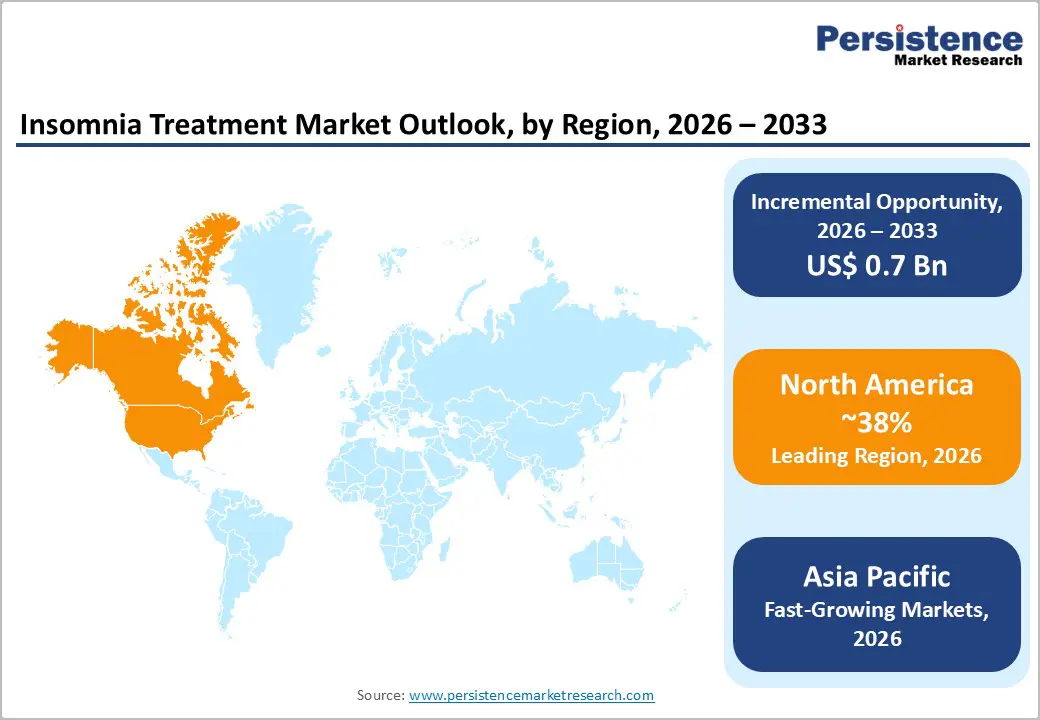
North America leads the global insomnia treatment market, supported by high disorder prevalence, advanced healthcare infrastructure, and strong mental health awareness. The region shows rapid adoption of both novel pharmacological therapies and digital CBT-I platforms. Asia Pacific, meanwhile, is emerging as a high-growth region due to urbanization, work-related stress, expanding healthcare access, and increasing acceptance of digital health solutions, positioning it as a strategically important market.
Checkout Now & Download Complete Market Report: https://www.persistencemarketresearch.com/checkout/23203
Companies Covered in Insomnia Treatment Market
Merck & Co., Inc.
Pfizer Inc.
Sanofi S.A.
Eisai Co., Ltd.
Takeda Pharmaceutical Company Limited
Teva Pharmaceutical Industries Ltd.
Vanda Pharmaceuticals Inc.
Idorsia Ltd
Johnson & Johnson
GlaxoSmithKline plc
Bayer AG
Competitive Landscape
The insomnia treatment market remains highly competitive and fragmented, with companies focusing on safer drug formulations, extended-release molecules, and digital therapy integration. Strategic partnerships, acquisitions, and investments in AI-guided CBT-I platforms are shaping competition. In December 2025, Boots Online Doctor launched a new insomnia treatment service offering personalized care plans, sleep hygiene guidance, and prescription access, highlighting the growing convergence of digital health and insomnia management solutions.
Market Segmentation
By Treatment Type
Pharmacological Therapies
Prescription Sleep Aids
Over-the-Counter (OTC) Drugs
Non-Pharmacological Therapies
By Distribution Channel
Hospital Pharmacies
Retail Pharmacies
Online Pharmacies
Sleep Management Clinics
Direct-to-Consumer Digital Platforms
By Region
North America
Europe
East Asia
South Asia and Oceania
Latin America
Middle East and Africa
Read Related Reports:
Combination Inhalers Market: The global combination inhalers market valued at US$ 8.8 billion in 2026, projected to reach US$ 13.5 billion by 2033, growing at a 6.3% CAGR.
Vectorized Antibodies Market: The global vectorized antibodies market is set to grow from US$ 4.9 billion in 2026 to US$ 7.7 billion by 2033, registering a compound Annual Growth Rate of 6.7%.
Persistence Market Research
Persistence Market Research Pvt Ltd
+1 646-878-6329
email us here
Visit us on social media:
LinkedIn
Instagram
Facebook
YouTube
X
Legal Disclaimer:
EIN Presswire provides this news content "as is" without warranty of any kind. We do not accept any responsibility or liability for the accuracy, content, images, videos, licenses, completeness, legality, or reliability of the information contained in this article. If you have any complaints or copyright issues related to this article, kindly contact the author above.
