

AI Is a Business Strategy, Not an IT Project — Lessons from Kellie Romack on the CAIO Connect Podcast with Sanjay Puri

CAIO Connect Podcast
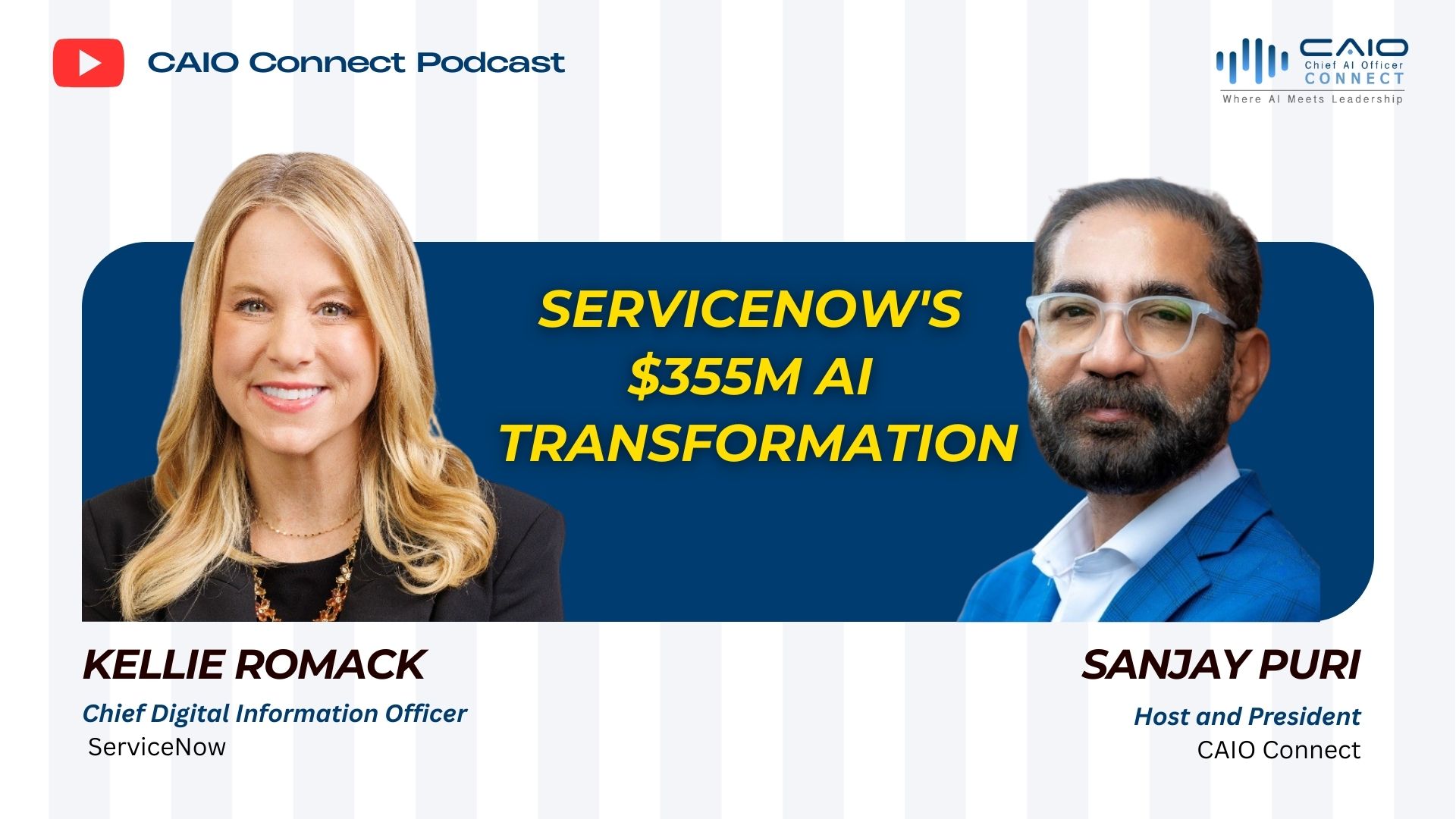
Kellie Romack, Chief Digital Information Officer at ServiceNow with Sanjay Puri, President, Knowledge Networks
AI doesn’t fail on tech; it fails on leadership. Lessons from Sanjay Puri’s conversation with Kellie Romack on making AI work through workflow, people, & value.
That single line from Kellie Romack, Chief Digital Information Officer at ServiceNow, perfectly captured the heart of her conversation with host Sanjay Puri on the CAIO Connect Podcast. In a world obsessed with AI models, pilots, and demos, Romack offered something far more valuable: a grounded, human-centered blueprint for making AI actually work at scale.
The message was clear from the start — AI success has far less to do with technology and far more to do with leadership, workflow, and context.
One Principle That Scales Everywhere: Experience First
Having led digital transformation across hospitality (Hilton), retail (Walmart), and enterprise software (ServiceNow), Romack emphasized one universal rule: great experiences drive transformation. And she defines “customers” broadly — not just external users, but employees and partners as well.
When organizations design AI without prioritizing employee experience, adoption stalls. When AI is embedded into seamless, end-to-end workflows, productivity follows.
AI Transformation Without Losing People
One of the most compelling moments in the podcast was Romack’s discussion of workforce transformation. Drawing from her experience making difficult decisions during COVID in hospitality, she explained how AI must be human-led, not human-replacing.
At ServiceNow, her team built an autonomous IT service desk that resolves 90% of requests without human intervention. Instead of eliminating roles, they upskilled and redeployed employees into higher-value work — managing, improving, and scaling AI systems.
The results?
* Double-digit employee satisfaction increases
* Faster resolution times
* Better experiences for 28,000 employees
As Sanjay Puri noted during the conversation, this wasn’t just the moral choice — it was a smart business decision.
Don’t Automate the Old — Reinvent the Work
Romack repeatedly warned against a common leadership trap: putting AI on top of broken processes. AI, she argued, should not automate inefficiency — it should eliminate it.
Her favorite example involved sales commissions. What was once a four-day, ticket-heavy process was completely reinvented using AI and confidential computing. The result? Eight seconds. No tickets. No friction.
That’s not automation. That’s reinvention.
Workflow Is the Unit of Value
Throughout the Chief AI Officer Podcast episode, Romack returned to one theme: workflow matters more than tools. Standalone AI experiences create “swivel chair” work — employees jumping between systems, contexts, and screens.
True productivity comes when AI, data, and orchestration work together inside the flow of daily work. This philosophy underpins ServiceNow’s approach to agentic AI, where multiple agents collaborate securely under orchestration, rather than operating in silos.
Governance Accelerates — It Doesn’t Slow You Down
Romack also tackled fears around rogue AI agents and regulation. Her reframing was powerful: if governance is embedded early, rogue agents never happen.
ServiceNow’s AI Control Tower gives leaders visibility into adoption, usage, and — critically — business value, not just technical metrics. Responsible AI, she emphasized, is not bureaucracy; it’s a trust accelerator.
The Real Reason AI Fails
According to Romack, AI projects fail for three leadership reasons:
1. Automating old processes instead of reimagining workflows
2. Treating AI as an IT project, not a business strategy
3. Building siloed solutions
As she told Sanjay Puri, AI doesn’t fail on technology — it fails on leadership.
A Call to Future AI Leaders
Romack closed the conversation with advice for aspiring Chief AI Officers: stay curious, lead with empathy, and master context. Technical skills matter, but human skills matter more.
As highlighted on the CAIO Connect Podcast, the future of AI leadership isn’t about chasing hype. It’s about reinventing work, investing in people, and embedding AI where it truly belongs — inside the workflow.
Upasana Das
Knowledge Networks
email us here
Visit us on social media:
LinkedIn
Instagram
Facebook
YouTube
X
Legal Disclaimer:
EIN Presswire provides this news content "as is" without warranty of any kind. We do not accept any responsibility or liability for the accuracy, content, images, videos, licenses, completeness, legality, or reliability of the information contained in this article. If you have any complaints or copyright issues related to this article, kindly contact the author above.
